1106 stories
·
0 followers

Study shows how rocket launches pollute the atmosphere

1 Share

New research published Thursday bolsters growing concerns that a handful of companies and countries are using the global atmospheric commons as a dumping ground for potentially toxic and climate-altering industrial waste byproducts from loosely regulated commercial space flights.

The new study analyzed a plume of pollution trailing part of a Falcon rocket that crashed through the upper atmosphere on Feb. 19, 2025, after SpaceX lost control of its reentry. The rocket was launched earlier that month, carrying 20 to 22 Starlink satellites into orbit.

The authors said it is the first time debris from a specific spacecraft disintegration has been traced and measured in the near-space region about 80 to 110 kilometers above Earth. Changes there can affect the stratosphere, where ozone and climate processes operate. Until recent years, human activities had little impact in that region.

Element-specific monitoring could be part of a broader effort to track how re-entry emissions spread and accumulate, the researchers noted, giving policymakers a chance to understand and manage the growing atmospheric footprint of spaceflight.

“I was surprised how big the event was, visually,” lead author Robin Wing, a researcher at the Leibniz Institute of Atmospheric Physics, said via email. He said people across northern Europe captured images of the burning debris, which was concentrated enough to enable high-resolution observations and to use atmospheric models to trace the lithium to its source.

The study shows that instruments can detect rocket pollution “in the ‘Ignorosphere’ (upper atmosphere near space),” he wrote. “There is hope that we can get ahead of the problem and that we don’t run blind into a new era of emissions from space.”

SpaceX did not immediately respond to questions or requests for comment from Inside Climate News.

A 2024 report from the United Nations University found that the rapid growth of commercial space activity is outpacing unevenly followed and voluntary guidelines. Without more global monitoring and collaboration, the rising demand for satellite launches will accelerate pollution risks in the shared space environment, the report warned.

International agreements covering rocket pollution include the Outer Space Treaty and Liability Convention. They require countries to avoid harmful contamination and to accept responsibility for damage caused by their space objects. Those principles are reflected by several International Court of Justice rulings and opinions on preventing cross-border environmental harm. Debris and atmospheric pollution from space launches disperses globally, affecting many nations that do not launch rockets at all.

Potential climate impacts

Research led by scientists with the National Oceanic and Atmospheric Administration, published in 2025, concluded that emissions from disintegrated satellites are likely to increase sharply in the coming decades. Some projections suggest as many as 60,000 satellites could be in orbit by 2040, with reentries every one to two days, injecting up to 10,000 metric tons of aluminum oxide particles into the upper atmosphere each year.

The study found that those aerosols could warm parts of the upper atmosphere by about 1.5 degrees Celsius within one or two years of reaching that number of satellites. That could alter winds and ozone chemistry, and persist for years, indicating a rapidly growing human-made source of pollution at the highest levels of the atmosphere.
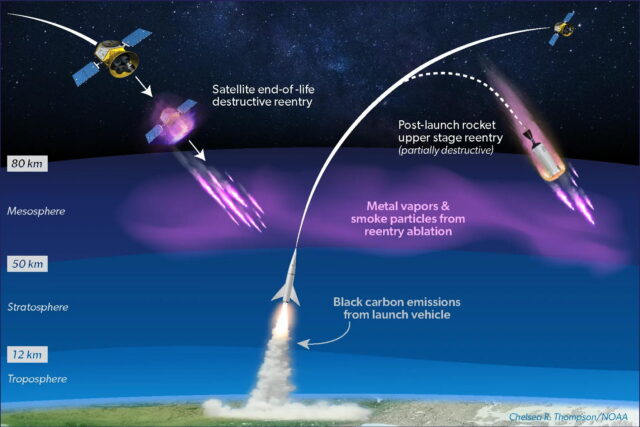
Illustration of different layers of Earth's atmosphere The various layers of Earth’s atmosphere and how satellites vaporize as they hit the mesosphere at the end of their lifetimes. This process seeds the middle and upper atmosphere with metal vapors, aerosols, and smoke particles. The mesosphere is also where naturally occurring meteors vaporize. The ozone layer lies within the stratosphere. Credit: Chelsea Thompson/NOAA

Those particles matter because they act like other catalytic aerosols in the upper atmosphere. Aluminum oxide dust from burning spacecraft absorbs and scatters sunlight and can warm areas where it accumulates. That can subtly change atmospheric circulation, the researchers noted. As the particles drift and settle lower into the stratosphere, they can affect ozone chemistry and high-altitude clouds, altering how sunlight and heat move through the atmosphere and potentially influencing climate over time.

The potential scope of impacts from space activities was outlined by several researchers at the 2025 European Geosciences Union conference in Vienna. They said that, beyond orbital debris, the booming space industry is the source of a new form of atmospheric pollution, injected directly into the layers of air that protect the planet and regulate its climate.

Atmospheric scientist Laura Revell, with the University of Canterbury in New Zealand, presented research showing that rocket exhaust in the atmosphere can erase some of the hard-won gains in mitigating ozone depletion.

In a high-growth scenario for the space industry, there could be as many as 2,000 launches per year, which her modeling shows could result in about 3 percent ozone loss, equal to the atmospheric impacts of a bad wildfire season in Australia. She said most of the damage comes from chlorine-rich solid rocket fuels and black carbon in the plumes.

The black carbon could also warm parts of the stratosphere by about half-a-degree Celsius as it absorbs sunlight. That heats the surrounding air and can shift winds that steer storms and areas of precipitation.

“This is probably not a fuel type that we want to start using in massive quantities in the future,” she added.

Researchers at the conference estimated that in the past five years, the mass of human‑made material injected into the upper atmosphere by re‑entries has doubled to nearly a kiloton a year. For some metals like lithium, the amount is already much larger than that contributed by disintegrating meteors.

In the emerging field of space sustainability science, researchers say orbital space and near-space should be considered part of the global environment. A 2022 journal article co-authored by Moriba Jah, a professor of aerospace engineering and engineering mechanics at the University of Texas at Austin, argued that the upper reaches of the atmosphere are experiencing increased impacts from human activities.

The expanding commercial use of what appears to be a free resource is actually shifting its real costs onto others, the article noted.

At last year’s European Geosciences Union conference, Leonard Schulz, who studies space pollution at the Technical University Braunschweig in Germany, said, “If you put large amounts of catalytic metals in the atmosphere, I immediately think about geoengineering.”

There may not be time to wait for more scientific certainty, Schulz said: “In 10 years, it might be too late to do anything about it.”

Bob Berwyn is an Austria-based reporter who has covered climate science and international climate policy for more than a decade. Previously, he reported on the environment, endangered species and public lands for several Colorado newspapers, and also worked as editor and assistant editor at community newspapers in the Colorado Rockies.

This story originally appeared on Inside Climate News.
Read full article

Comments


Read the whole story
Share this story
Delete

Fishing crews in the Atlantic keep accidentally dredging up chemical weapons

1 Share

Until 1970, the US dumped an estimated 17,000 tons of unspent chemical weapons from World War I and II off the coast of the Atlantic Ocean—and that disposal decision continues to haunt commercial fishing operations.

In an article published this week in the Morbidity and Mortality Weekly Report, health officials from New Jersey and the Centers for Disease Control and Prevention report that there were at least three incidents of commercial fishing crews dredging up dangerous chemical warfare munitions (CWMs) off the coast of New Jersey between 2016 and 2023.

The three incidents exposed at least six crew members to mustard agent, which causes blistering chemical burns on skin and mucous membranes. (An example of these types of burns can be seen here, but be warned, the image is graphic.) One crew member required overnight treatment in an emergency department for respiratory distress and second-degree blistering burns. Another was burned so badly that they were hospitalized in a burn center and required skin grafting and physical therapy.

"Recovered CWMs continue to pose worker and food safety risks. Because of ocean drift, storms, and offshore industries, sea-disposed CWMs locations are largely unknown and potentially far from their originally documented dump site," the health officials write.

It's not the first such report in MMWR. In 2013, federal health officials reported another three incidents in the mid-Atlantic. The report noted that clam fishermen in Delaware Bay "told investigators that they routinely recover munitions that often 'smell like garlic,' a potential indication of the presence of a chemical agent."

In the three newly reported incidents, one occurred in 2016 off the coast of Atlantic City when a crew was dredging for clams. A munition was brought onboard on a conveyor belt. A crew member noticed it and threw it overboard, but it was subsequently the member who developed arm burns requiring skin grafting. Beyond the health toll, a delay in communicating the incident allowed the clams dredged alongside the munition to move into production. This led to a recall of 192 cases of clam chowder and the destruction of 704 cases of clams.

In 2017, an intact crate containing 20 sulfur mustard canisters came up off the coast of Long Beach. The crate became tangled in fishing equipment and broke the vessel's sorting machinery, exposing three members to the munitions. The crew member who freed the crate developed second-degree burns on the forearms. After that, 5,300 bushels of purchased surf clams had to be sanitized and destroyed.

In 2023, a leaking CWM came up off the coast of Cape May. The crew member who tossed it back in the ocean spent the night in an emergency department with respiratory distress and burns.

While tossing the munitions back into the sea raises the risk that they'll simply be dredged up again, the health officials behind the report note that it actually appears to be the safest way for crew members to respond in such incidents. According to US laws, CWMs that have been in the ocean for decades are considered abandoned and degraded to the point that they're not considered to be dangerous military weapons, despite the reports. There is no requirement that they be recovered and destroyed.

In all, the best thing fishing crews can do is be aware of known dumping sites, have personal protective equipment available, and report any incident and seek prompt health care. Such incidents require coordinated responses with the US Coast Guard, Food and Drug Administration, state and local authorities, and fishing and seafood operations.

Read full article

Comments


Read the whole story
Share this story
Delete

Humanity Heating Planet Faster Than Ever Before, Study Finds

2 Shares
An anonymous reader The Guardian: Humanity is heating the planet faster than ever before, a study has found. Climate breakdown is occurring more rapidly with the heating rate almost doubling, according to research that excludes the effect of natural factors behind the latest scorching temperatures. It found global heating accelerated from a steady rate of less than 0.2C per decade between 1970 and 2015 to about 0.35C per decade over the past 10 years. The rate is higher than scientists have seen since they started systematically taking the Earth's temperature in 1880. "If the warming rate of the past 10 years continues, it would lead to a long-term exceedance of the 1.5C (2.7F) limit of the Paris agreement before 2030," said Stefan Rahmstorf, a scientist at the Potsdam Institute for Climate Impact Research and co-author of the study. [...] The researchers applied a noise-reduction method to filter out the estimated effect of nonhuman factors in five major datasets that scientists have compiled to gauge the Earth's temperature. In each of them, they found an acceleration in global heating emerged in 2013 or 2014. The findings have been published in the journal Geophysical Research Letters.

Read more of this story at Slashdot.

Read the whole story
Share this story
Delete

Tech industry is in tariff hell, even if refunds are automated

1 Share

It's been two weeks since the Supreme Court blocked Donald Trump's emergency tariffs, but an estimated 300,000 US businesses still have no idea if or when they will receive refunds.

Economists have estimated that more than $175 billion was unlawfully collected, and the US could end up owing substantially more than that the longer that the refund process is dragged out, since the US must pay back daily interest on the funds. According to the Cato Institute, a libertarian think tank, a conservative estimate showed that "$700 million in interest is added to the final bill every month that the government delays tariff refunds, or around $23 million per day."

The US is aware that interest is compounding daily on tariffs, as the Trump administration argued against an injunction that would've temporarily blocked the tariffs much sooner by noting that no one would be harmed, since tariffs would be repaid with interest if deemed unlawful. However, now that the court has ruled against tariffs, the Trump administration seems to be dragging its feet in finding a way to return all the ill-gotten funds.

Ed Brzytwa, vice president of international trade for the Consumer Technology Association (CTA), told Ars that delays seem counter to US interests at this point.

"The government should have an intrinsic interest in providing these new funds as fast as possible, so they don't owe more interest over time," Brzytwa said. Providing refunds sooner, he suggested, would not just benefit companies, but "to their employees, to the US economy, to US consumers, all the above."

For the tech industry, many popular products have been spared hundreds of billions in tariffs since Trump took office, but, as the CTA documented in repeated court filings, many more products were hit by them. Ahead of midterms, when analysts predict that tariff whipsawing might slow down, tech firms remain uncertain about when to expect refunds, experts told Ars. At a time when firms already feel overwhelmed, they're also navigating new tariffs that areraising new legal challenges, while risking more supply chain strains as additional threats of feared tariff stacking loom.

Refunds should be automated, CTA argued

Pressure is increasing on Trump to deliver refunds faster; however, after a US Court of International Trade judge, Richard Eaton, ordered universal refunds for all importers who paid Trump's emergency tariffs on Wednesday. At a hearing that day, Eaton noted that Customs knows how to issue refunds, later ordering that all claims be efficiently resolved, CNBC reported.

Officials from Customs and Border Protection (CBP) are expected to share an update on their proposed refund plans at a hearing Friday in that case, raised by Atmus Filtration, which reportedly paid about $11 million in unlawful tariffs.

In the meantime, the CTA and the Chamber of Commerce (CoC) filed a motion to submit a proposed brief in another tariffs lawsuit outlining what the trade groups believe is the best strategy for handling refunds.

That lawsuit, raised by V.O.S. Selections, is being overseen by a different Court of International Trade judge, Gary Katzmann. The groups are hoping that he may agree with Eaton, who noted at the Wednesday hearing that "the agency should be able to program its system to issue refunds," CNBC reported. The trade groups' proposed brief emphasized that "in fact, CBP has already issued refunds for some of those tariffs because they were retroactively reduced by a subsequent trade agreement."

According to the trade groups, the US government has the technology to streamline—and possibly even automate—tariff refunds.

"They have the technology to do it," Brzytwa said. "They offer refunds to importers all the time."

But apparently, the Trump administration so far lacks the will to use it, instead planning to wait for court direction before taking any steps to send the funds back. So now the court must intervene to draft a blueprint that all businesses can use to secure a quick and easy refund, the groups said.

"There is no question that American businesses are now entitled to the return of the billions of dollars they were forced to pay under these unlawful tariffs," the groups wrote. "The law is clear on that point, and the government has repeatedly stated that it would issue refunds if the tariffs were ultimately deemed invalid."

If the court requires each business to either litigate their claims or go through "impractical" CBP administrative procedures to request refunds, either the courts or CBP will be overwhelmed, the groups argued. Dealing with the backlog could drag out refunds for years, while the interest accrues and the most vulnerable businesses risk being forced to shut down, they argued.

For many small firms with tight profit margins, the emergency tariffs "have already stretched their resources to the breaking point," groups wrote.

"Those are the types of companies that need to be prioritized in a refund plan," Brzytwa said. He suggested the court should require officials to take steps "to help the companies that barely are making it at this point because they paid such steep amounts in tariffs."

Perhaps even more concerning to the court, for any firms that end up negatively weighing the costs of a lengthy legal battle with the government against likely much smaller tariff refunds, some claims may be abandoned. That would, troublingly, leave taxes collected unlawfully under the International Emergency Economic Powers Act (IEEPA) in the Trump administration's hands, groups warned.

"There is no need to individually litigate whether particular IEEPA duties were valid—they are all invalid," the groups wrote. Instead, groups urged the court to "craft an injunction facilitating a streamlined administrative process for plaintiffs in this case to use in obtaining their refunds." That same process could become "a blueprint for other importers to secure refunds," they suggested.

Possibly, a "commonsense" court-ordered solution could be easily created to streamline refunds, groups proposed.

"Because the government has tracked the payment of IEEPA tariff duties, it knows who paid them and in what amounts, even without refund-seeking submissions from the affected importers," the groups said. Later on, they added, "this efficiency is important not only to reduce strain on courts and the government, but to ensure that refunds issue on a defined and predictable timeline. Delay should not become a de facto denial of recovery for importers who paid unlawful tariffs and wish to seek appropriate relief."

Dallas Dolen—a technology, media, and telecommunications leader for PwC, a leading global professional services network that advises big firms on tax questions—told Ars that he's also worried that tariff refund fights will drag on for years without a court-ordered pathway to expedite them.

Until courts clarify how the refund process will work, he said that PwC continues to advise companies to "be really organized, be really prepared." Every business impacted should stop now to assess what tariffs they expect they’re owed and possibly hire staff to ensure they're prepared to secure a refund when processes are created, PwC advised. That level of preparedness may be critical, since "it's unlikely the government will write them two checks," Dolen said.

It may be time for Trump to rethink tariffs

Dolen suggested that consumer technology might be the sector of the tech industry most hurt by tariffs, and even if refunds are automated, alternative tariffs that Trump is threatening to impose could change the calculus on refunds.

According to Dolen, some businesses required to pay new tariffs under Section 122 of the Trade Act of 1974 may instead get a gross refund, possibly subtracting Trump's latest 10 percent global tariffs from the total of IEEPA tariffs owed.

Perhaps complicating the math further, those new tariffs could increase before refunds are issued. Just yesterday, Treasury Secretary Scott Bessent said that Section 122 tariffs could be raised by another 15 percent this week, The New York Times reported. And over the next five months, the tech industry could be paying tariffs at the same levels as under Trump's IEEPA tariffs, Bessent has claimed.

However, Trump's tariffs remain hugely unpopular, even with Republicans. Both experts agreed that Trump will likely be more thoughtful about tariffs ahead of the midterms. And since he's unlikely to get much support from Congress members focused on reelection, any changes will likely come by executive order. Dolen suggested that Trump's concerns about inflation from tariffs may make him less willing to impose them.

"Restraint's probably not the perfect word," but the president may start exhibiting "a little more contemplation and thoughtfulness," Dolen suggested.

Brzytwa told Ars that the CTA is also hoping that the back-to-back court rulings might push Trump to rethink his aggressive tariff strategy—especially given that his goals of increasing US manufacturing are not being achieved by them.

"This is a golden opportunity for them to reassess on whether they want to impose more tariffs, because if you impose more tariffs, you create more chaos, you create more uncertainty. and you raise costs again," Brzytwa said.

Another wrinkle is that the Supreme Court ruling has emboldened critics of Trump's tariffs. Although Trump and Bessent have postured that the Supreme Court ruling is meaningless, since they have other tariff avenues to explore, those will not replace his prior IEEPA tariffs, Brzytwa said. And the administration already is facing legal pressure that could gut the Section 122 authority to impose tariffs, after 20 states sued Trump to block his next go-to tariff tool.

But Trump seems unlikely to give up tariffs as a source of leverage in negotiations with all of America's trading partners, and sometimes even in negotiations with US companies. And even if Section 122 tariffs are one day blocked, just as IEEPA tariffs were, Brzytwa told Ars that CTA is "very closely" monitoring additional tariffs that could be imposed under Section 232 of the Trade Expansion Act and Section 301 of the Trade Act of 1974. Those could hit products like semiconductors or critical minerals, as well as any downstream products containing them, perhaps further hurting cash-strapped tech firms stuck feeling fuzzy about what costs or supply chain disruption may come in the near future.

Read full article

Comments


Read the whole story
Share this story
Delete

Leading AI, data center companies sign pledge to buy their own power

1 Share

On Wednesday, the Trump administration announced that a large collection of tech companies had signed on to what it's calling the Ratepayer Protection Pledge. By agreeing, the initial signatories—Amazon, Google, Meta, Microsoft, OpenAI, Oracle, and xAI—are saying they will pay for the new generation and transmission capacities needed for any additional data centers they build. But the agreement has no enforcement mechanism, and it will likely run into issues with hardware supplies. It also ignores basic economics.

Other than that, it seems like a great idea.

What's being agreed to

The agreement is quite simple, laying out five points. The key ones are the first three: that the companies building data centers pledge to pay for new generating capacity, either building it themselves or paying for it as part of a new or expanded power plant. They'll also pay for any transmission infrastructure needed to connect their data centers and the new supply to the grid and will cover these costs whether or not the power ultimately gets used by their facilities.

The companies also pledge to consider allowing the local grid to use on-site backup generators to handle emergency power shortages affecting the community. They will also hire and train locally when they build new data centers.

The agreement suggests that these promises will protect American consumers from price hikes due to the expansion of data centers and will somehow "lower electricity costs for consumers in the long term." How that will happen is not specified.

Also missing from the agreement is any sort of enforcement mechanism. If a company decides to ignore the agreement, the worst it is guaranteed to suffer is bad publicity, something these companies already have experience handling. That said, Trump has been known to resort to blatantly illegal tactics to pressure companies to conform to his wishes, so ignoring the agreement carries risks.

That's important because the companies will struggle to live up to the agreement. (Though Google, for its part, told Ars that it has typically followed the guidelines as a normal part of its process for building new data centers.)

And even if they could, it wouldn't insulate the US public from energy price increases.

Meet basic economics

As recent coverage has made clear, most of the companies plan to handle (or are already handling) the added power demand with natural-gas-generating equipment. But there's a limited supply of such equipment; various sources quote wait times of up to seven years. That's longer than even the planned timeline for a new nuclear power plant. While there's likely to be some expanded manufacturing capacity due to the surging demand, the companies that build gas turbines will be very hesitant to invest in meeting demand that is likely to be transient.

Even if they did, basic economics indicate that expanded use of this fuel would raise consumer costs, as it would mean more competition for the supply of natural gas used either directly by consumers for heating or by grid operators that supply consumers with electricity. That will likely force utilities to meet demand with plants that are rarely used at present, typically because those plants are less efficient and more expensive to run.

This is also coming at a time when the US's liquefied natural gas exports have already forced utilities to shift to expensive coal generation, contributing to a 6 percent rise in consumer electricity costs in 2025 alone. (You can contrast that increase with the announcement's claim that "President Trump has demonstrated consistent leadership in expanding domestic energy supply and lowering energy prices for consumers.") Europe is a major customer for those exports, and it has likely just lost access to roughly 10 percent of its imports from Qatar.

So it's very unlikely that data center builders will be able to meet the added demands with natural gas. Even if they could, it would shift costs onto consumers unless we somehow scaled natural gas production to match while keeping overseas consumers from buying the excess.

Are there alternatives? We haven't built any coal plants in decades, and many of the ones still in operation are reaching their normal end-of-life points; the electricity they produce is also expensive relative to the alternatives. It's highly unlikely that anyone would invest in new coal plants given the cost and environmental consequences.

Nuclear is a questionable option. There are plans to restart a couple of shuttered plants—the secretary of energy is holding a press conference at one at Indian Point in New York on Friday, suggesting further efforts in that regard. But there simply aren't enough shuttered plants to make a difference. The administration is promoting small modular nuclear power and hopes to have some test reactors built within the next few years. But it will likely take considerably longer than that before they can be widely deployed.

That leaves a combination of solar and batteries as one of the most viable alternatives, although it's still more expensive than most natural gas plants at present. That combination is already being installed at record paces—solar output in the US has grown by over 30 percent for two years in a row. It's not clear how much faster we could be installing them, and in any case, it's clear that the administration doesn't view them as a solution. The announcement specifically takes a shot at policies favoring renewable energy, saying, "President Trump terminated the job-killing 'Green New Scam,' ended massive taxpayer subsidies for unreliable energy sources, and rescinded the Biden Administration’s anti-American energy regulations."

Whatever is built will also face the general challenge that transmission remains a huge problem, with many proposed power plants waiting in the queue for years for interconnects to the wider grid.

Supplying the data center boom with power in a way that's minimally disruptive to the wider public will be an extremely difficult challenge. Dismissing it with a toothless agreement that hopes the companies involved will solve all the problems is not cause for optimism that we're prepared to meet that challenge.

Read full article

Comments


Read the whole story
Share this story
Delete

RFK Jr. can promote getting measles with impunity, DOJ lawyer tells judge

1 Share

A lawyer for the Trump administration told a federal judge Wednesday that anti-vaccine Health Secretary Robert F. Kennedy Jr. has such ample authority over the country's vaccine policies that he is "unreviewable." His unfettered powers even allow Kennedy the freedom to recommend, if he chose to do so, that people ditch vaccines and actively expose themselves to infectious diseases, the lawyer argued, according to Reuters.

The comments came amid a lawsuit filed against Kennedy by the American Academy of Pediatrics, several other medical groups, and three anonymous women. The suit challenges a number of Kennedy's actions on vaccine policy since he took office, including his unilateral changes to COVID-19 vaccine policies, his firing of all 17 expert vaccine advisors for the Centers for Disease Control and Prevention—whom Kennedy replaced with hand-picked anti-vaccine allies—and his decision to dramatically overhaul the CDC's childhood vaccine schedule to match that of the small country of Denmark, dropping the total number of recommended vaccinations from 17 to 11 and making the US an outlier among high-income countries.

The groups are seeking a preliminary injunction to block the vaccine policy changes and bar the new advisors from meeting. Their next meeting is scheduled for March 18–19.

US Department of Justice lawyer Isaac Belfer argued that Kennedy has the broad authority to make all of the changes he has already made and more. He claimed that the AAP and other medical groups were asking the court to "supervise vaccine policy indefinitely."

US District Judge Brian Murphy overseeing the case in Boston appeared skeptical of the suggestion that Kennedy has seemingly limitless authority over federal vaccine policy.

"Is it your position that [Kennedy] is totally ​unreviewable?" Murphy asked Belfer, according to Reuters. "If the secretary said instead of getting a shot to prevent measles I think you should get a shot that gives you measles, is that unreviewable?"

"Yes," Belfer replied.

Belfer, arguing on behalf of the Department of Health and Human Services, said the medical organizations were merely seeking to use the courts to enact their favored vaccine policy. But the lawyer for the groups, James Oh, countered that the vaccine policy changes—which were not carried out with typical processes and lack supporting scientific evidence—were done improperly and without reasoned decision-making.

Kennedy's vaccine policy changes are the "actions of someone who believes he can do whatever he wants," Oh said, according to Stat News.

Murphy indicated he would issue a ruling on the injunction before the CDC vaccine advisors plan to meet on March 18, calling it a "hard deadline."

Read full article

Comments


Read the whole story
Share this story
Delete
Next Page of Stories